In Italy, tirocinio (internship) is one word for two different things. The one you do while you study, which earns you credits or hours towards your qualification, is a curricular internship. The one you do after your qualification, or in any case outside a course of study, is an extracurricular internship. Who organises it, which rules apply and whether you are owed an allowance all change. One thing does not: in neither case are you hired. Quotations from Italian sources are our translation.
The legal definition
Law 234/2021, Article 1, paragraph 720, defines the internship as "a training pathway alternating study and work, aimed at guidance and vocational training, also to improve the matching of labour demand and supply". It adds: "Where it serves to obtain a formally recognised qualification, the internship is defined as curricular".
The test is simple. If the internship counts towards your qualification (a degree, an ITS diploma, a secondary school diploma), it is curricular. If not, it is extracurricular.
The curricular internship: your school or university sets the rules
The Ministry of Labour describes it as an internship "for young people attending a course of education or training": it is "governed by the regulations of the school or university" and "promoted by schools, universities or accredited training bodies".
In practice the promoting body is your university, your ITS Academy or your school. The rules on duration, hours and credits are in their regulations, not in a regional law. The oldest national reference, Ministerial Decree 142/1998, already lists among the promoters "universities and institutions of university education" and "state and non-state schools that award qualifications with legal value" (Art. 2).
The same decree says that the activities carried out during the internship "may count as training credits" and, if certified by the promoter, may be recorded in your CV (Art. 6).
The extracurricular internship: the Region sets the rules
For the Ministry, the extracurricular internship is "aimed at helping young people make career choices through a period of training in a productive setting", and is "governed by the Regions and the Autonomous Provinces". At national level, the same page adds, "common minimum standards are nonetheless defined", including those on the minimum allowance. Among its references, the page lists the Guidelines approved by the Agreement between the Government, the Regions and the Autonomous Provinces of 25 May 2017.
On the allowance, Law 234/2021 is explicit. The guidelines on internships "other than curricular ones" must provide for "the recognition of a fair participation allowance" (paragraph 721), and anyone who fails to pay it faces an administrative fine of between 1,000 and 6,000 euros (paragraph 722). The law also sets a ceiling: an extracurricular internship may not exceed "twelve months in total for each group of companies" (paragraph 726-bis).
The minimum amount that applies to you is not in a national law: your Region's rules set it. Before you sign, look it up on the Region's website or ask the job centre or the body promoting the internship.
Neither is an employment contract
The sources agree on this. Paragraph 723 of Law 234/2021: "The internship does not constitute an employment relationship and may not be used to replace employed work". Ministerial Decree 142/1998, Art. 1: relationships with interns "do not constitute employment relationships". The Ministry puts it in bold: the internship "is not an employment relationship".
Two things follow. First, you have no salary and none of an employee's rights: you have a training pathway with a written objective. Second, the company may not use you to fill a vacant post. If you find yourself doing an employee's job full time with nobody supervising you, talk to the promoter's tutor.
The health and safety rules still fall on the company: the host must comply "in full" with Legislative Decree 81/2008 towards its interns (paragraph 725).
The people and the documents
In both cases there are two bodies and two tutors. There is a promoting body (a university, a school, an ITS Academy, a job centre, a training body) and a host (a company, a professional practice, a public body). According to the Ministry, the promoter and the host "each appoint a tutor", who help you draft the training plan and follow how it goes.
The internship starts from an agreement between promoter and host. For each intern, the agreement comes with a training project. Ministerial Decree 142/1998 (Art. 4) says what it must contain:
- objectives and how the internship is carried out, linked, for students, to their course of study;
- the names of the promoter's tutor and of the company contact;
- the details of the insurance cover;
- duration and period;
- the company department you join.
At the end, the Ministry writes, your skills and results "are recorded in the training booklet" (libretto formativo).
What to ask them to write
The training project and the tutor's final evaluation are the two documents that last. If someone else writes them in a hurry, they only say that you were there: a period, a department, a number of hours. If they are written well, they describe a real project. You can ask for that.
In the training project, before you start:
- concrete objectives tied to a specific piece of work: not "shadowing the technical office" but "designing and drafting the drawings of a fixture for the assembly line";
- the expected result, meaning what will exist at the end (a document, a prototype, a procedure, an analysis);
- the department and the tools you will use: software, machines, methods.
In the tutor's evaluation, at the end:
- what you did, in the words of the job, not just "punctual and interested";
- what you did on your own and what you did with a colleague;
- what of your work was actually used.
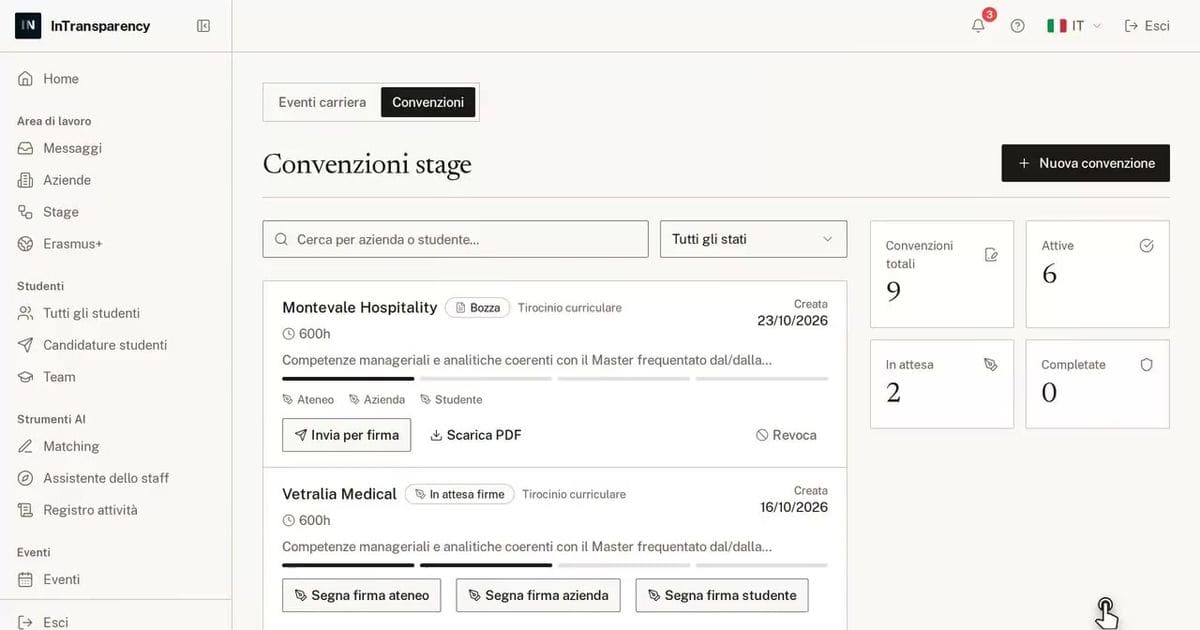
That is where a skill sits next to the work it comes from. When you apply for jobs, that sentence from your tutor will serve you better than a line saying "three-month internship at…". If your school or university uses InTransparency, the internship appears in your area, under "My Internship": there you log your hours and find your tutors' evaluations.
The practical step
Before you sign, ask the promoter's tutor to read the training project with you. If the objectives are vague, suggest a concrete sentence about the work you will do. If the internship is extracurricular, also check the minimum allowance set by your Region. At the end, ask the company tutor to write in the evaluation what you produced: for you, it is proof of work done.